
Background
Auditory hallucinations (AH), the perception of hearing sounds or voices in the absence of external stimuli, are among the most common and debilitating psychotic symptoms of schizophrenia spectrum disorders (SSD).1–3 Approximately 60-80% of the 23 million individuals diagnosed with an SSD experience AH.4,5 The voices heard by individuals with AH are often described as threatening or derogatory,6 and are linked to an elevated risk of suicide, violence, disability, depression, and impaired functioning.6–10 Unfortunately, existing pharmacological11 and psychological12 treatments for AH show only modest benefits in symptom reduction.13,14 Hence, alternative, effective interventions are required to treat AH.
Virtual reality (VR) therapies have shown promise in the treatment of AH in SSDs.15–19 In VR therapy, individuals interact with controlled computer-generated environments that mirror real-world settings in which, some form of psychotherapy is typically guided by a therapist.20 VR was initially introduced as a treatment for anxiety and trauma-related disorders,21 and has repeatedly been found to be more effective than certain other treatments, including cognitive behavioural therapy (CBT), mindfulness therapy, and usual care,22–24 due to its ability to create a strong sense of presence in augmented environments (i.e., the subjective experience of being physically and psychologically present within the virtual environment, such that it feels real), reducing distress.25 This paper adopts a broad definition of VR, encompassing both immersive or 3D and non-immersive or 2D modalities. Immersive VR involves head-mounted displays or motion-tracking and stereoscopic display technology, while non-immersive VR involves interaction with 2D environments on a standard screen.26 Both forms of VR have demonstrated efficacy in the treatment of psychiatric disorders, including SSD.27
The aim of the present systematic review and meta-analysis was to assess the efficacy of immersive and non-immersive VR therapies for treating AH in SSDs.
Methods
This systematic review and meta-analysis followed Preferred Reporting Items for Systematic Reviews and Meta-Analyses (PRISMA) guidelines.28
Data sources and search Strategy
A comprehensive literature search was conducted on Embase, APA PsychInfo, and MEDLINE via the Ovid Database to identify studies prior to August 2025.
Eligibility criteria
The eligibility criteria for study inclusion were as follows:
- Population: individuals ≥ 18 years of age, experiencing AH, diagnosed with SSD using the Diagnostic and Statistical Manual of Mental Disorders29 or International Classification of Diseases.30
- Interventions: studies that use immersive and non-immersive forms of VR.
- Comparators: only randomized controlled trials (RCTs) or randomized partial cross-over trials were included. Active controls, such as a VR control, CBT and supportive counselling, as well as treatment-as-usual (TAU) controls, were considered acceptable.
- Outcome measures: Eligible studies were required to report a quantitative measure of change in auditory hallucinations (AH), either as a primary or secondary outcome. The primary outcome for this review was AH severity, defined as the intensity of hallucinations and their impact on the individual.
Statistical analysis
Meta-analysis
R Studio (2024.09.1+394)31 was used to conduct the meta-analyses in instances where at least 2 studies had the required data available. The primary analyses examined the efficacy of the VR intervention versus control group on AH severity post-intervention and at follow-up. Standardized mean differences (SMDs) were calculated for both treatment and control groups using the mean difference (MD) from baseline to the endpoint and the standard deviation (SD) of the mean differences.32 Hedges’ g was interpreted using conventional thresholds for effect size: small (0.2), medium (0.5), and large (0.8).33
Results
Search results
Nine studies (n = 1,019) met the eligibility criteria for the systematic review and eight (n = 1,004) met the criteria for the meta-analyses. All studies measured AH outcomes using the PSYRATS-AH subscale.34 PSYRATS-AH measures AH severity through 11 questions, with each question being scored on a range from 0 to 4, with higher scores meaning worse AH severity.34 AH severity scores range from 0-44.34
Meta-analysis
Immediate post-intervention effects of VR on AH severity
VR was significantly more effective in reducing AH severity (Figure 1), with a small to medium effect size (Hedges’ g = −0.41, 95% CI [−0.62, −0.20], p < 0.01). This translates to a between-group estimated mean difference of 2.5 (6.0) points on the PSYRATS-AH subscale.
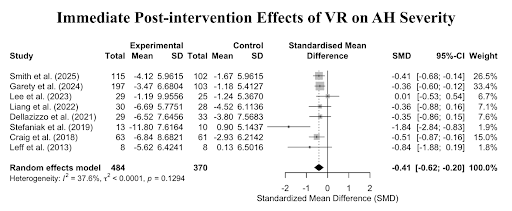
Figure 1. Forest plot of the meta-analysis comparing immediate post-intervention changes in auditory hallucination (AH) severity between VR and control conditions. Standardized mean difference (SMD): Negative values indicate greater VR effectiveness, while positive values indicate greater control group effectiveness.
Sustained effects of VR on AH severity
VR was significantly more effective than the control condition in reducing AH severity (Figure 2), with a small to moderate effect size: Hedges’ g = −0.28, 95% CI [−0.40, −0.17], p < 0.001. This translates to a between-group estimated mean difference of 1.7 (6.0) points on the PSYRATS-AH subscale.
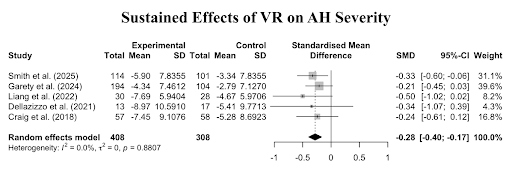
Figure 2. Forest plot of the meta-analysis comparing sustained changes in auditory hallucination (AH) severity scores from baseline to follow-up between virtual reality (VR) and control conditions. Standardized mean difference (SMD): Negative values indicate greater VR effectiveness, while positive values indicate greater control group effectiveness.
Discussion
AH are debilitating, frequently persistent symptoms of SSD,1–3 often attributable to poor treatment engagement35,36 and limited efficacy of established treatments.37,12–14 VR therapies yielded small-to-moderate pooled effects in reducing AH severity immediately post-intervention and at follow-up extending up to 52 weeks.
The results seemed to be driven primarily by a therapy known as Avatar Therapy (AT), a VR therapy that can be both immersive and non-immersive.38–47 In AT, patients create an avatar that resembles the perceived voice and face of their AH and directly engage with it in simulated dialogue, with a therapist animating the avatar and simultaneously guiding the participants’ conversations with the persecutory avatar.48 Several theoretical mechanisms may account for the efficacy of AT in reducing AH. AT incorporates key psychotherapeutic components such as therapist-interaction, cognitive restructuring, and behavioural modification which may have led to the observed reduction in AH.38 Another theory proposes that the advantage of AT may stem from a controlled virtual environment that enables individuals to directly communicate with their voices, which is proposed to create a positive relationship with them, reduce feeling of helplessness, and ultimately reduce AH.38,40,42,49–52 The VR environment may also enhance the subjective sense of being present in the virtual environment (i.e., sense of presence), which can strengthen emotional engagement with the intervention and support the therapeutic process. Studies on VR have found that a higher sense of presence is associated with greater reductions in AH severity, supporting its role in VR’s effectiveness.53–55
Limitations
The small number of eligible studies reflects the current early stage of research in this domain and may impact the reliability of findings. Due to the small sample size, methodological differences across studies such as variations in intervention length and follow-up periods, may have introduced heterogeneity.
Future Directions
Given this study’s limitations, future research should focus on conducting larger, well-powered RCTs on the effectiveness of VR interventions for AH in SSD with differing lengths of treatments and follow-up periods. Once VR’s effectiveness has been established, its feasibility and cost-effectiveness in broader clinical settings should be evaluated. This includes implementation in primary care environments and community mental health centers, as an adjunctive treatment alongside antipsychotic medication.
Conclusion
This systematic review and meta-analysis provide preliminary evidence that AT delivered through VR may be an effective intervention for reducing AH severity in individuals with SSD. Across both immediate and long-term follow-up timepoints, VR-based AT demonstrated significant reductions in AH severity in several comparisons with established treatments (i.e., antipsychotic medications, CBT, and supportive counselling/psychotherapy). The limited number of studies on this topic suggests that more research is needed to reliably assess the efficacy of VR-delivered therapies for AH reduction in SSDs and to justify VR as a scalable addition to conventional treatments (i.e., antipsychotic medication) for individuals diagnosed with SSDs.
The full paper can be found here: https://doi.org/10.1093/schbul/sbag052
Edited by: Kealyn McDowell
References
1. Shao, X., Liao, Y., Gu, L., Chen, W., & Tang, J. (2021). The Etiology of Auditory Hallucinations in Schizophrenia: From Multidimensional Levels. Frontiers in Neuroscience, 15. https://doi.org/10.3389/fnins.2021.755870
2. Nayani, T. H., & David, A. S. (1996). The auditory hallucination: A phenomenological survey. Psychological Medicine, 26(1), 177–189. https://doi.org/10.1017/S003329170003381X
3. Sheaves, B., Johns, L., Griffith, L., Isham, L., Panel, T. M. H. V. L. E. A., Kabir, T., & Freeman, D. (2020). Why do patients with psychosis listen to and believe derogatory and threatening voices? 21 reasons given by patients. Behavioural and Cognitive Psychotherapy, 48(6), 631–645. https://doi.org/10.1017/S1352465820000429
4. Schizophrenia. (n.d.). Retrieved October 6, 2025, from https://www.who.int/news-room/fact-sheets/detail/schizophrenia
5. Lim, A., Hoek, H. W., Deen, M. L., Blom, J. D., Bruggeman, R., Cahn, W., de Haan, L., Kahn, R. S., Meijer, C. J., Myin-Germeys, I., van Os, J., & Wiersma, D. (2016). Prevalence and classification of hallucinations in multiple sensory modalities in schizophrenia spectrum disorders. Schizophrenia Research, 176(2), 493–499. https://doi.org/10.1016/j.schres.2016.06.010
6. Larøi, F., Thomas, N., Aleman, A., Fernyhough, C., Wilkinson, S., Deamer, F., & McCarthy-Jones, S. (2019). The ice in voices: Understanding negative content in auditory-verbal hallucinations. Clinical Psychology Review, 67, 1–10. https://doi.org/10.1016/j.cpr.2018.11.001
7. Landmark, J., Merskey, H., Cernovsky, Z., & Helmes, E. (1990). The Positive Triad of Schizophrenic Symptoms: Its Statistical Properties and its Relationship to 13 Traditional Diagnostic Systems. The British Journal of Psychiatry, 156(3), 388–394. https://doi.org/10.1192/bjp.156.3.388
8. Baethge, C., Baldessarini, R. J., Freudenthal, K., Streeruwitz, A., Bauer, M., & Bschor, T. (2005). Hallucinations in bipolar disorder: Characteristics and comparison to unipolar depression and schizophrenia. Bipolar Disorders, 7(2), 136–145. https://doi.org/10.1111/j.1399-5618.2004.00175.x
9. Fujita, J., Takahashi, Y., Nishida, A., Okumura, Y., Ando, S., Kawano, M., Toyohara, K., Sho, N., Minami, T., & Arai, T. (2015). Auditory verbal hallucinations increase the risk for suicide attempts in adolescents with suicidal ideation. Schizophrenia Research, 168(1), 209–212. https://doi.org/10.1016/j.schres.2015.07.028
10. Knippenberg, A. R., Yavari, S., & Strauss, G. P. (2025). Negative auditory hallucinations are associated with increased activation of the defensive motivational system in schizophrenia. Schizophrenia Research: Cognition, 39, 100334. https://doi.org/10.1016/j.scog.2024.100334
11. Patel, K. R., Cherian, J., Gohil, K., & Atkinson, D. (2014). Schizophrenia: Overview and Treatment Options. Pharmacy and Therapeutics, 39(9), 638–645.
12. Jauhar, S., McKenna, P. J., Radua, J., Fung, E., Salvador, R., & Laws, K. R. (2014). Cognitive–behavioural therapy for the symptoms of schizophrenia: Systematic review and meta-analysis with examination of potential bias. The British Journal of Psychiatry, 204(1), 20–29. https://doi.org/10.1192/bjp.bp.112.116285
13. Tarrier, N., Yusupoff, L., Kinney, C., McCarthy, E., Gledhill, A., Haddock, G., & Morris, J. (1998). Randomised controlled trial of intensive cognitive behaviour therapy for patients with chronic schizophrenia. BMJ (Clinical Research Ed.), 317(7154), 303–307. https://doi.org/10.1136/bmj.317.7154.303
14. Buckley, L. A., Maayan, N., Soares‐Weiser, K., & Adams, C. E. (2015). Supportive therapy for schizophrenia. The Cochrane Database of Systematic Reviews, 2015(4), CD004716. https://doi.org/10.1002/14651858.CD004716.pub4
15. Freeman, D. (2008). Studying and Treating Schizophrenia Using Virtual Reality: A New Paradigm. Schizophrenia Bulletin, 34(4), 605–610. https://doi.org/10.1093/schbul/sbn020
16. Macedo, M., Marques, A., & Queirós, C. (2015). Virtual reality in assessment and treatment of schizophrenia: A systematic review. Jornal Brasileiro de Psiquiatria, 64, 70–81. https://doi.org/https://doi.org/10.1590/0047-2085000000059
17. Rus-Calafell, M., Garety, P., Sason, E., Craig, T. J. K., & Valmaggia, L. R. (2018). Virtual reality in the assessment and treatment of psychosis: A systematic review of its utility, acceptability and effectiveness. Psychological Medicine, 48(3), 362–391. https://doi.org/10.1017/S0033291717001945
18. Bisso, E., Signorelli, M. S., Milazzo, M., Maglia, M., Polosa, R., Aguglia, E., & Caponnetto, P. (2020). Immersive Virtual Reality Applications in Schizophrenia Spectrum Therapy: A Systematic Review. International Journal of Environmental Research and Public Health, 17(17), Article 17. https://doi.org/10.3390/ijerph17176111
19. Gillouin, P.-A., Mattatia, D., & Bouvet, C. (2024). Virtual reality for clinical evaluation and treatment in schizophrenia: A systematic review. Psychosis, 16(2), 212–229. https://doi.org/10.1080/17522439.2023.2197030
20. Botella, C., Quero, S., Baños, R. M., Perpiñá, C., García Palacios, A., & Riva, G. (2004). Virtual reality and psychotherapy. Studies in Health Technology and Informatics, 99, 37–54.
21. Rothbaum, B. O., Hodges, L. F., Kooper, R., Opdyke, D., Williford, J. S., & North, M. (1995). Effectiveness of computer-generated (virtual reality) graded exposure in the treatment of acrophobia. The American Journal of Psychiatry, 152(4), 626–628. https://doi.org/10.1176/ajp.152.4.626
22. Zeng, W., Xu, J., Yu, J., & Chu, X. (2025). Effectiveness of virtual reality therapy in the treatment of anxiety disorders in adolescents and adults: A systematic review and meta-analysis of randomized controlled trials. Frontiers in Psychiatry, 16, 1553290. https://doi.org/10.3389/fpsyt.2025.1553290
23. Eshuis, L. V., van Gelderen, M. J., van Zuiden, M., Nijdam, M. J., Vermetten, E., Olff, M., & Bakker, A. (2021). Efficacy of immersive PTSD treatments: A systematic review of virtual and augmented reality exposure therapy and a meta-analysis of virtual reality exposure therapy. Journal of Psychiatric Research, 143, 516–527. https://doi.org/10.1016/j.jpsychires.2020.11.030
24. Carl, E., Stein, A. T., Levihn-Coon, A., Pogue, J. R., Rothbaum, B., Emmelkamp, P., Asmundson, G. J. G., Carlbring, P., & Powers, M. B. (2019). Virtual reality exposure therapy for anxiety and related disorders: A meta-analysis of randomized controlled trials. Journal of Anxiety Disorders, 61, 27–36. https://doi.org/10.1016/j.janxdis.2018.08.003
25. Park, M. J., Kim, D. J., Lee, U., Na, E. J., & Jeon, H. J. (2019). A Literature Overview of Virtual Reality (VR) in Treatment of Psychiatric Disorders: Recent Advances and Limitations. Frontiers in Psychiatry, 10, 505. https://doi.org/10.3389/fpsyt.2019.00505
26. Fusco, A., & Tieri, G. (2022). Challenges and Perspectives for Clinical Applications of Immersive and Non-Immersive Virtual Reality. Journal of Clinical Medicine, 11(15), Article 15. https://doi.org/10.3390/jcm11154540
27. Cieślik, B., Mazurek, J., Rutkowski, S., Kiper, P., Turolla, A., & Szczepańska-Gieracha, J. (2020). Virtual reality in psychiatric disorders: A systematic review of reviews. Complementary Therapies in Medicine, 52, 102480. https://doi.org/10.1016/j.ctim.2020.102480
28. Page, M. J., McKenzie, J. E., Bossuyt, P. M., Boutron, I., Hoffmann, T. C., Mulrow, C. D., Shamseer, L., Tetzlaff, J. M., Akl, E. A., Brennan, S. E., Chou, R., Glanville, J., Grimshaw, J. M., Hróbjartsson, A., Lalu, M. M., Li, T., Loder, E. W., Mayo-Wilson, E., McDonald, S., … Moher, D. (2021). The PRISMA 2020 statement: An updated guideline for reporting systematic reviews. BMJ, 372, n71. https://doi.org/10.1136/bmj.n71
29. American Psychiatric Association. (2013). Diagnostic and statistical manual of mental disorders: DSM-5. https://thuvienso.hoasen.edu.vn/handle/123456789/9853
30. Keeley, J. W., & Gaebel, W. (2018). Symptom rating scales for schizophrenia and other primary psychotic disorders in ICD-11. Epidemiology and Psychiatric Sciences, 27(3), 219–224. https://doi.org/10.1017/S2045796017000270
31. RStudio. (n.d.). Posit. Retrieved March 26, 2025, from https://www.posit.co/
32. Deeks, J. J., & Higgins, J. (2007). Box 9.8.a: The Cochrane Statistical Methods Group. https://handbook-5-1.cochrane.org/chapter_9/box_9_8_a_the_cochrane_statistical_methods_group.htm
33. Hedges, L. V., & Vevea, J. L. (1998). Fixed- and random-effects models in meta-analysis. Psychological Methods, 3(4), 486–504. https://doi.org/10.1037/1082-989X.3.4.486
34. Haddock, G., McCarron, J., Tarrier, N., & Faragher, E. B. (1999). Scales to measure dimensions of hallucinations and delusions: The psychotic symptom rating scales (PSYRATS). Psychological Medicine, 29(4), 879–889. https://doi.org/10.1017/s0033291799008661
35. Zhang, T., Wang, J., Xu, L., Wei, Y., Tang, X., Hu, Y., Cui, H., Tang, Y., Li, C., Ling, Z., & Wang, J. (2022). Further evidence that antipsychotic medication does not prevent long-term psychosis in higher-risk individuals. European Archives of Psychiatry and Clinical Neuroscience, 272(4), 591–602. https://doi.org/10.1007/s00406-021-01331-2
36. Kane, J. M., Kishimoto, T., & Correll, C. U. (2013). Non-adherence to medication in patients with psychotic disorders: Epidemiology, contributing factors and management strategies. World Psychiatry: Official Journal of the World Psychiatric Association (WPA), 12(3), 216–226. https://doi.org/10.1002/wps.20060
37. Howes, O. D., McCutcheon, R., Agid, O., de Bartolomeis, A., van Beveren, N. J. M., Birnbaum, M. L., Bloomfield, M. A. P., Bressan, R. A., Buchanan, R. W., Carpenter, W. T., Castle, D. J., Citrome, L., Daskalakis, Z. J., Davidson, M., Drake, R. J., Dursun, S., Ebdrup, B. H., Elkis, H., Falkai, P., … Correll, C. U. (2017). Treatment-Resistant Schizophrenia: Treatment Response and Resistance in Psychosis (TRRIP) Working Group Consensus Guidelines on Diagnosis and Terminology. The American Journal of Psychiatry, 174(3), 216–229. https://doi.org/10.1176/appi.ajp.2016.16050503
38. du Sert, O. P., Potvin, S., Lipp, O., Dellazizzo, L., Laurelli, M., Breton, R., Lalonde, P., Phraxayavong, K., O’Connor, K., Pelletier, J.-F., Boukhalfi, T., Renaud, P., & Dumais, A. (2018). Virtual reality therapy for refractory auditory verbal hallucinations in schizophrenia: A pilot clinical trial. Schizophrenia Research, 197(American Psychiatric Association. (2013). Diagnostic and Statistical Manual of Mental Disorders (5th ed). (Washington, D.C). 2013-14907-000.), 176–181. APA PsycInfo <2018>. https://doi.org/10.1016/j.schres.2018.02.031
39. Leff, J., Williams, G., Huckvale, M. A., Arbuthnot, M., & Leff, A. P. (2013). Computer-assisted therapy for medication-resistant auditory hallucinations: Proof-of-concept study. The British Journal of Psychiatry, 202(6), 428–433. https://doi.org/10.1192/bjp.bp.112.124883
40. Craig, T. K., Rus-Calafell, M., Ward, T., Leff, J. P., Huckvale, M., Howarth, E., Emsley, R., & Garety, P. A. (2018). AVATAR therapy for auditory verbal hallucinations in people with psychosis: A single-blind, randomised controlled trial. The Lancet. Psychiatry, Comment in: Lancet Psychiatry. 2018 Jan;5(1):2-3 PMID: 29175275 [Https://Www.Ncbi.Nlm.Nih.Gov/Pubmed/29175275] Erratum in: Lancet Psychiatry. 2018 Jan;5(1):E1 PMID: 29198384 [Https://Www.Ncbi.Nlm.Nih.Gov/Pubmed/29198384], 5(1), 31–40. Ovid MEDLINE(R) <2018>. https://doi.org/10.1016/S2215-0366(17)30427-3
41. Stefaniak, I., Sorokosz, K., Janicki, A., & Wciorka, J. (2019). Therapy based on avatar-therapist synergy for patients with chronic auditory hallucinations: A pilot study. Schizophrenia Research, 211(Chadwick, P., Birchwood, M. (1994). The omnipotence of voices. A cognitive approach to auditory hallucinations. Br. J. Psychiatry, 164, 190-201. https://pubmed.ncbi.nlm.nih.gov/8173822 https://dx.doi.org/10.1192/bjp.164.2.190 1994-34382-001.), 115–117. APA PsycInfo <2019>. https://doi.org/10.1016/j.schres.2019.05.036
42. Dellazizzo L., Potvin S., Phraxayavong K., & Dumais A. (2021). One-year randomized trial comparing virtual reality-assisted therapy to cognitive-behavioral therapy for patients with treatment-resistant schizophrenia. Npj Schizophrenia, 7(1), 9. Embase (2010482310). https://doi.org/10.1038/s41537-021-00139-2
43. Garety, P. A., Edwards, C. J., Jafari, H., Emsley, R., Huckvale, M., Rus-Calafell, M., Fornells-Ambrojo, M., Gumley, A., Haddock, G., Bucci, S., McLeod, H. J., McDonnell, J., Clancy, M., Fitzsimmons, M., Ball, H., Montague, A., Xanidis, N., Hardy, A., Craig, T. K. J., & Ward, T. (2024). Digital AVATAR therapy for distressing voices in psychosis: The phase 2/3 AVATAR2 trial. Nature Medicine, 1–11. https://doi.org/10.1038/s41591-024-03252-8
44. Smith, L. C., Vernal, D. L., Mariegaard, L. S., Christensen, A. G., Jansen, J. E., Schytte, G., Stokbro, L. A., Albert, N., Christensen, M. J., Thomas, N., Hjorthøj, C., Nordentoft, M., & Glenthøj, L. B. (2025). Immersive virtual reality-assisted therapy targeting persistent auditory verbal hallucinations in patients diagnosed with schizophrenia spectrum disorders in Denmark: The Challenge assessor-masked, randomised clinical trial. The Lancet Psychiatry, 12(8), 557–567. https://doi.org/10.1016/S2215-0366(25)00161-0
45. Liang N., Li X., Guo X., Liu S., Liu Y., Zhao W., Wen Y., Li Y., Li F., Wu H., Li J., Li Q., Guo J., & Xu Y. (2022). Visual P300 as a neurophysiological correlate of symptomatic improvement by a virtual reality-based computer AT system in patients with auditory verbal hallucinations: A Pilot study. Journal of Psychiatric Research, 151, 261 EP – 271. Embase (2017949621). https://doi.org/10.1016/j.jpsychires.2022.04.027
46. Franco, M., Monfort, C., Piñas-Mesa, A., & Rincon, E. (2021). Could Avatar Therapy Enhance Mental Health in Chronic Patients? A Systematic Review. Electronics, 10(18), 2212. https://doi.org/10.3390/electronics10182212
47. Aali, G., Kariotis, T., & Shokraneh, F. (2020). Avatar Therapy for people with schizophrenia or related disorders. The Cochrane Database of Systematic Reviews, 5(100909747), CD011898. Ovid MEDLINE(R) <2020>. https://doi.org/10.1002/14651858.CD011898.pub2
48. Vass E., Gerlinger L., Egervari L., Kilencz T., Csukly G., Herman L., Rethelyi J., Farkas K., Mariegaard L., Glenthoj L.B., & Simon L. (2024). Exploring the acceptability, and feasibility of a modified virtual reality-based AVATAR therapy in schizophrenia spectrum disorders: A case series report. Acta Psychologica, 250, 104520. Embase Weekly Updates (645530411). https://doi.org/10.1016/j.actpsy.2024.104520
49. Corstens, D., Longden, E., & May, R. (2012). Talking with voices: Exploring what is expressed by the voices people hear. Psychosis, 4(2), 95–104. https://doi.org/10.1080/17522439.2011.571705
50. Hayward, M., Jones, A.-M., Bogen-Johnston, L., Thomas, N., & Strauss, C. (2017). Relating Therapy for distressing auditory hallucinations: A pilot randomized controlled trial. Schizophrenia Research, 183, 137–142. https://doi.org/10.1016/j.schres.2016.11.019
51. Pérez-Álvarez, M., García-Montes, J. M., Perona-Garcelán, S., & Vallina-Fernández, O. (2008). Changing relationship with voices: New therapeutic perspectives for treating hallucinations. Clinical Psychology & Psychotherapy, 15(2), 75–85. https://doi.org/10.1002/cpp.563
52. Longden, E., Corstens, D., Morrison, A. P., Larkin, A., Murphy, E., Holden, N., Steele, A., Branitsky, A., & Bowe, S. (2021). A treatment protocol to guide the delivery of dialogical engagement with auditory hallucinations: Experience from the Talking With Voices pilot trial. Psychology and Psychotherapy: Theory, Research and Practice, 94(3), 558–572. https://doi.org/10.1111/papt.12331
53. Dai, R., Kim, J., Choi, H., Shin, Y., Kim, B.-N., Kim, S., Kim, K., & Kim, J. S. (2025). Evaluation of virtual reality-based guided imagery stabilization intervention for post-traumatic stress symptoms: A randomized controlled trial. Virtual Reality, 29(4), 151. https://doi.org/10.1007/s10055-025-01225-x
54. Augustin E., Beaudoin M., Giguere S., Ziady H., Phraxayavong K., & Dumais A. (2024). The Relationship between Sense of Presence, Emotional Response, and Clinical Outcomes in Virtual Reality-Based Therapy for Treatment-Resistant Schizophrenia: An Exploratory Correlational Study. Journal of Personalized Medicine, 14(6), 614. Embase Weekly Updates (2030352617). https://doi.org/10.3390/jpm14060614
55. Vasudha, V., & Choudhary, S. (2026). Virtual reality and embodiment: Rethinking self-construction and identity in therapeutic contexts. Frontiers in Virtual Reality, 7. https://doi.org/10.3389/frvir.2026.1756137